

August 1, 2025

When a door fails in a commercial building, the hardware is usually the first suspect. For facility managers, contractors, and locksmiths, knowing exactly what type of lock you are working with determines how fast you can diagnose the problem, order the right part, and get the door back in service.
Commercial mortise locks are the most common locking mechanism in high-traffic commercial buildings: hospitals, schools, office buildings, government facilities, and hotels. But they are frequently misidentified as cylindrical or tubular locks, especially during quick walkthroughs or maintenance calls. That misidentification costs time and money.
This guide covers how to identify a commercial mortise lock in the field, what ANSI/BHMA grade specifications mean for your application, how installation differs from other lock types, and how a mortise compares to cylindrical and tubular alternatives.
Quick Answer:
A commercial mortise lock is identified by a rectangular lock body recessed into a pocket cut into the edge of the door. Key visual markers include a thin rectangular faceplate on the door edge, a lever with a large rectangular or sectional escutcheon (not a round rose), and a cylinder positioned separately from the latch. Commercial mortise locks meeting ANSI/BHMA A156.13 Grade 1 are tested to 1 million operational cycles and are standard for high-traffic doors in schools, hospitals, and commercial office buildings.
What Is a Mortise Lock?
A commercial mortise lock is a lock body installed inside a recessed pocket cut into the edge of the door, known as the mortise. Unlike cylindrical or tubular locks, which are bored through the face of the door, a mortise lock sits entirely within the door's core. That installation method gives it greater structural integrity and makes it the preferred choice for doors that see constant, heavy use.
The lock body houses multiple mechanisms in a single case: a latchbolt, a deadbolt (on most commercial functions), and an anti-friction latch to ease lever operation. That self-contained design is what separates a commercial mortise lock from other hardware types and why it is the standard on commercial doors in high-security and high-traffic applications.
How to Identify a Commercial Mortise Lock
Several visual and physical cues confirm you are working with a mortise lock rather than a cylindrical or tubular unit.
- Rectangular faceplate on the door edge: A thin metal plate is visible on the edge of the door, typically secured by two small screws. This is the armor front of the mortise case. Cylindrical and tubular locks do not have this.
- Large escutcheon or sectional trim: Mortise locks use a rectangular escutcheon trim or sectional trim (two separate pieces for the lever and cylinder) on both sides of the door. Cylindrical and tubular locks use a single round rose that wraps around the lever or knob.
- Cylinder position: The keyway cylinder on a mortise lock sits independently above or below the lever, not inside it. On a cylindrical lock, the cylinder is integrated directly into the lever chassis.
- Lock body size and depth: Once the faceplate is removed, a mortise case will measure between 3 and 5 inches deep and 3.5 to 4.5 inches tall. The case is rectangular and made of heavy-gauge steel.
- Weight: Commercial mortise locks are significantly heavier than cylindrical or tubular locks due to the multi-component steel case.
How to Confirm the Lock Type in the Field
To determine whether you are working with a mortise lock, you can take the following steps:
- Remove the faceplate screws on the door edge and pull the faceplate to expose the case edge.
- Measure the depth of the mortise pocket. A depth of 3 to 5 inches confirms a mortise lock.
- Look for a manufacturer name or part number stamped on the case or faceplate. Use that information to verify the exact model and function.
- Check the trim mounting holes. Mortise locks have a distinct spacing pattern compared to cylindrical locks. Manufacturer installation templates are available online and confirm hole prep patterns definitively.
- Inspect the escutcheon shape. Rectangular or sectional trim means mortise. Round rose means cylindrical or tubular.
What Are ANSI/BHMA Grade Specifications for Commercial Mortise Locks?
ANSI/BHMA (American National Standards Institute / Builders Hardware Manufacturers Association) grade classifications are the industry standard for evaluating door hardware performance. For mortise locks, the governing standard is ANSI/BHMA A156.13.
There are three grade levels under this standard:
- Grade 1: The highest performance classification. Hardware must withstand a minimum of 1 million operational cycles and meet stringent security and durability requirements. Grade 1 is required for high-traffic commercial applications including healthcare, education, government, and institutional buildings.
- Grade 2: Intermediate performance. Tested to 250,000 cycles. Suitable for light commercial or multifamily applications.
- Grade 3: Residential performance level. Not appropriate for commercial use.
For any commercial application, Grade 1 is the minimum acceptable specification. Building codes, architectural specifications, and many insurance requirements mandate it on primary access doors and corridors.
What does Grade 1 mean in practice? Grade 1 mortise locks are built to handle thousands of cycles per day across a product lifespan measured in decades, not years. The testing covers latch operation, deadbolt throw, lever torque, cylinder security, and overall case integrity under repeated mechanical stress.
PDQ's MR Series Grade 1 Mortise Lock is certified to ANSI/BHMA A156.13 Operational Grade 1 and Security Grade 1. In PDQ's own cycle testing, the MR Series exceeded the ANSI/BHMA standard by more than 11 times, reaching over 11 million cycles without failure. That performance margin matters on high-use doors where a Grade 1 lock near the minimum threshold may still wear out faster than expected.
Beyond cycle testing, ANSI/BHMA A156.13 Grade 1 certification for commercial mortise locks also requires compliance with:
- UL/CUL 10C listing for 3-hour fire-rated doors
- ADA (Americans with Disabilities Act) lever operation requirements: operable with one hand using no more than 5 lbs of force
- ICC/ANSI 117.1 accessibility standards for commercial buildings
Specifying architects and facility managers should always verify the ANSI/BHMA certification level, not just the grade claim, when evaluating commercial mortise lock options. Look for third-party certification documentation, not self-reported ratings.
Commercial Mortise Lock vs. Cylindrical and Tubular Locks
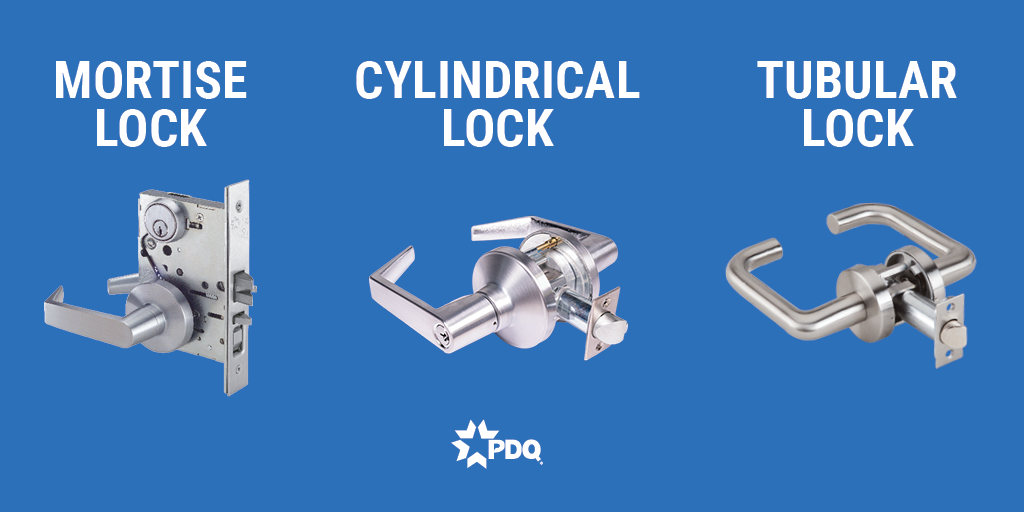
Understanding how a commercial mortise lock differs from other lock types helps you specify the right hardware from the start and avoid compatibility issues during replacement or retrofit projects.
Mortise vs. Cylindrical Locks
Cylindrical locks use a round chassis that fits through a bored hole in the face of the door. They are faster and less expensive to install than mortise locks. Grade 1 cylindrical locks are a legitimate option for many commercial doors, particularly in medium-traffic interior applications.
The key trade-off is function density. A mortise lock integrates a latchbolt, deadbolt, and anti-friction mechanism in a single case. Cylindrical locks often require a separate deadbolt to achieve equivalent security, adding cost and prep work. For doors requiring multiple locking functions, a mortise lock is almost always the more efficient specification.
Mortise locks also offer more function options (storeroom, office, classroom, corridor, and many others) in a single platform. That flexibility matters when specifying across a building with varied security requirements.
Mortise vs. Tubular Locks
Tubular locks are common in residential and low-traffic commercial settings. They are not engineered for the cycle demands of commercial environments. Tubular locks typically do not carry ANSI/BHMA A156.13 Grade 1 certifications, and their lighter-duty construction makes them unsuitable for primary access doors in commercial buildings.
From a door prep standpoint, tubular locks pass through the door (similar to cylindrical), while a mortise lock requires a deep pocket routed into the door edge. Tubular hardware cannot be retrofitted into a mortise prep, and vice versa, so identifying the existing lock type is critical before ordering any replacement.
Summary Comparison
| Feature | Commercial Mortise | Cylindrical (Grade 1) | Tubular |
|---|---|---|---|
| ANSI/BHMA Grade | Grade 1 | Grade 1 or 2 | Grade 2 or 3 |
| Door prep | Edge pocket (mortise) | Face-bored hole | Face-bored hole |
| Multi-function case | Yes | No | No |
| Best for | High-traffic commercial | Medium commercial / interior | Residential / low-traffic |
| Fire door rated | Yes (UL 10C) | Some models | Rarely |
| ADA compliant | Yes (lever models) | Yes (lever models) | Varies |
PDQ's MR Series is available in over 20 standard lockset functions, making it straightforward to match the right security function to each opening across a project.
Commercial Mortise Lock Installation Overview
Mortise lock installation requires more preparation than a cylindrical lock but follows a consistent process once the door is properly prepped. Understanding the basics helps facility managers and contractors verify correct installation and diagnose problems in the field.
Door Requirements
A standard commercial mortise lock requires a door that is 1-3/4 inches thick (the industry standard for commercial wood and hollow metal doors). Thicker doors (2 to 3 inches) are available as special orders from most manufacturers. The mortise pocket is typically routed into the door edge to a depth of 3 to 5 inches, depending on the lock case dimensions.
The standard backset for commercial mortise locks is 2-3/4 inches (measured from the door edge to the center of the cylinder). Confirm the backset before ordering a replacement to ensure the strike aligns correctly with the frame.
Installation Steps (Overview)
- Mark and rout the mortise pocket in the door edge to the exact depth and width specified by the manufacturer's installation template.
- Insert the lock case into the pocket and secure the armor front (faceplate) to the door edge with screws.
- Bore the trim holes in the door face for the cylinder and lever spindle, using the manufacturer's template to ensure correct spacing.
- Install the cylinder into the case from the exterior side.
- Attach the lever trim (escutcheon or sectional trim) on both sides of the door.
- Install the strike plate on the door frame, aligned to the latchbolt and deadbolt throw dimensions.
- Test all functions before closing up: latch retraction, deadbolt throw, cylinder operation, and egress function if applicable.
Field Reversibility
Most commercial mortise locks, including PDQ's MR Series, are field reversible. This means the handing (right-hand or left-hand swing) can be changed on-site without requiring a new lock case. Field reversibility reduces inventory requirements for facilities teams managing large building portfolios and simplifies last-minute changes during construction.
To reverse the handing on a mortise lock, you typically re-orient the latchbolt and adjust the spindle. Consult the manufacturer's installation instructions, as the process varies by function and case type.
When Do You Need to Identify a Commercial Mortise Lock?
There are several practical situations where confirming the exact lock type is the first step in any hardware decision.
- Routine maintenance: Identifying the lock type and model ensures you order compatible replacement parts the first time. The wrong latchbolt or cylinder can delay maintenance by days.
- Replacing damaged locks: Knowing the model number and function confirms that a replacement lock will fit the existing door prep and match the function required for that opening.
- Retrofitting for access control: Transitioning to electronic access control requires hardware compatibility. Mortise locks accept electrified trims and electric strikes differently than cylindrical locks. Misidentifying the existing hardware can result in incompatible integrations.
- Code compliance verification: ADA, fire code, and local building codes specify required lock functions and hardware performance levels for different door types. Verifying your current hardware against those requirements starts with knowing what you have.
- Spec replacement during renovation: Replacing hardware during a renovation project requires matching the existing door prep. Installing a cylindrical lock into a mortise prep requires filling the pocket, which adds cost and may not be structurally sound.
Frequently Asked Questions
Q: What is the difference between a commercial mortise lock and a cylindrical lock? A commercial mortise lock is installed into a pocket routed into the edge of the door, housing a multi-function case with a latchbolt and deadbolt in a single unit. A cylindrical lock is bored through the face of the door and typically handles one function per lockset. Mortise locks are standard for high-traffic commercial applications due to their greater durability, function density, and fire-rating compatibility.
Q: What ANSI/BHMA grade should a commercial mortise lock be? Commercial mortise locks in high-traffic buildings should be ANSI/BHMA A156.13 Grade 1, the highest performance classification for mortise hardware. Grade 1 requires a minimum of 1 million operational cycles and compliance with fire, security, and accessibility standards. Grade 2 is acceptable only for low-traffic commercial or multifamily applications.
Q: How do I know if I have a mortise lock or a cylindrical lock? Look at the door edge for a thin rectangular faceplate secured by two screws. That is the armor front of a mortise case. Also check the trim: mortise locks use a large rectangular escutcheon or sectional trim; cylindrical locks use a small round rose. If the cylinder is separate from the lever (not inside it), you have a mortise lock.
Q: How deep is the pocket for a commercial mortise lock? A commercial mortise lock case typically requires a pocket 3 to 5 inches deep in the door edge, depending on the manufacturer and function. Always measure the existing case before ordering a replacement, and confirm the door prep dimensions against the manufacturer's installation template.
Q: Can a mortise lock be field reversed? Most commercial mortise locks are field reversible, meaning the handing can be changed on-site from right-hand to left-hand (or reverse) without replacing the case. Check the manufacturer's documentation for the specific reversibility instructions for your lock function, as some functions require factory configuration.
Q: What certifications should I look for on a commercial mortise lock? For a commercial application, look for: ANSI/BHMA A156.13 Grade 1 (operational and security), UL/CUL 10C listing for fire-rated doors, and ADA/ICC/ANSI 117.1 compliance for accessibility. In hurricane-prone regions, look for Florida HVHZ (High Velocity Hurricane Zone) approval. Third-party certification documentation from the manufacturer confirms these ratings have been independently verified.
Key Takeaways
- A commercial mortise lock is identified by its rectangular faceplate on the door edge, large escutcheon trim, and separately positioned cylinder.
- ANSI/BHMA A156.13 Grade 1 is the required performance level for commercial mortise locks in high-traffic buildings: minimum 1 million cycles, fire-rated, and ADA compliant.
- Mortise locks offer greater function density and durability than cylindrical or tubular alternatives, making them the standard for healthcare, education, government, and institutional applications.
- The standard commercial mortise lock backset is 2-3/4 inches, and most models are field reversible to simplify installation and inventory management.
- Identifying your exact lock type before ordering replacement hardware prevents compatibility issues, reduces downtime, and ensures code compliance.
Ready to Specify a Commercial Mortise Lock?
PDQ's MR Series is ANSI/BHMA A156.13 Grade 1 certified, UL listed for 3-hour fire doors, ADA compliant, and backed by a lifetime limited warranty. Tested to over 11 million cycles, it has demonstrated more than 11 times the ANSI/BHMA minimum performance standard. It is assembled in Lancaster, PA and available in 10 lever styles, 8 finishes, and over 20 lockset functions.
Explore PDQ's MR Series Mortise Lock or contact a regional sales representative to discuss the right specification for your project.