November 1, 2026

When specifying hardware for your commercial building, panic hardware should be at the top of your priority list. Panic hardware is a life-safety requirement, not an aesthetic choice. Choosing the wrong exit device can result in a failed inspection, costly hardware changes, or, more importantly, severe safety risks, especially on openings governed by strict egress code requirements.
Exit devices also go by crash bar, push bar, and panic bar, to name a few. No matter what you refer to them as, they all describe the same hardware that is designed for safe and fast egress.
This guide breaks down what panic hardware is, how it works mechanically, the different exit device types you will encounter (Rim, Mortise, Surface Vertical Rod, and Concealed Vertical Rod), and how to choose the right one for your opening.
|
QUICK ANSWER Panic hardware (also called an exit device, crash bar, or push bar) is a door-mounted mechanism that lets people exit a building immediately by pushing against a horizontal bar or pad. It is required on doors serving high-occupancy or life-safety paths and is governed by ANSI/BHMA A156.3. PDQ's 6300 and 6400 Series exit devices are built to meet that standard across Rim, Mortise, and Vertical Rod configurations. |
In This Article
What Is Panic Hardware?
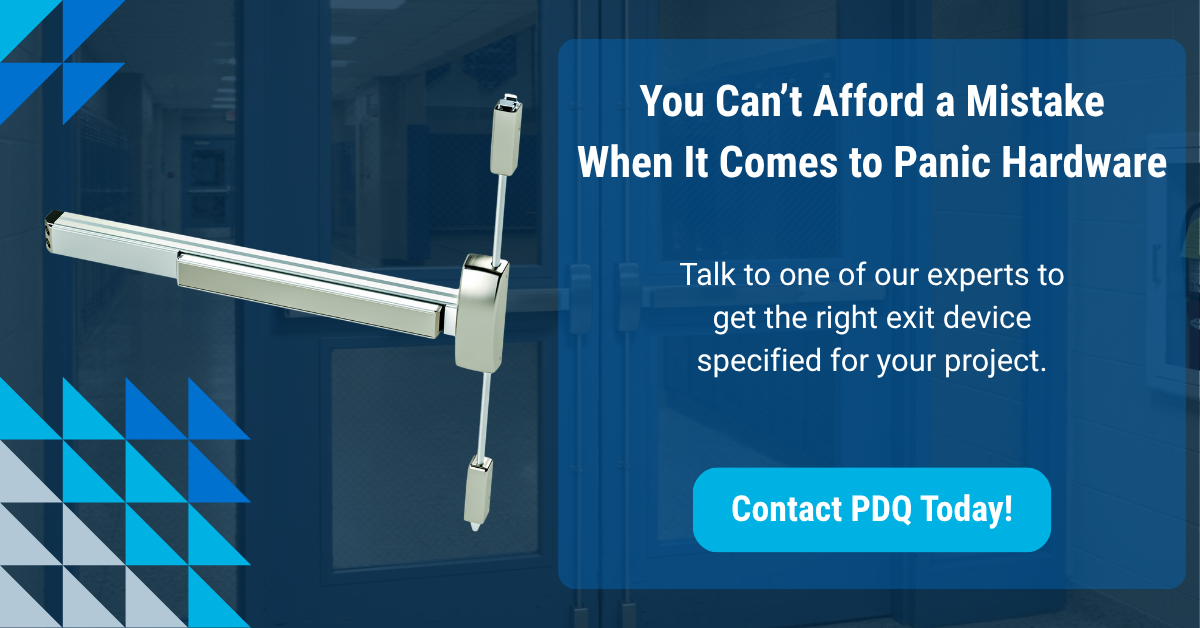
Panic hardware is a door-mounted release mechanism, typically a horizontal bar or push pad, that lets someone open a door by pushing against it, requiring no need for a knob, lever, or key. The horizontal force from the user’s pushing motion retracts the latch or bolt, so a person moving towards the door can exit in an efficient manner.
This same category of hardware goes by several names. Exit device is the formal term manufacturers and specifiers use. As touched on in the beginning, other common descriptions include panic bar, push bar, and crash bar. They all describe the same thing. "Panic hardware" and "panic bar" describe its life-safety purpose; "push bar" and "crash bar" describe how it physically operates.
Panic hardware for doors is formally governed by ANSI/BHMA A156.3, the American National Standards Institute/Builders Hardware Manufacturers Association standard that sets performance, cycle testing, and force requirements for exit devices, one part of the full range of commercial door hardware used on commercial openings.
Is a Crash Bar the Same Thing as Panic Hardware?
Yes. A crash bar on a door is the same thing as panic hardware. The terms exit device, crash bar on a door, and panic hardware are used interchangeably for the same egress mechanism.
How Does Panic Hardware Work?
Panic hardware isn’t rocket science; it’s designed to be simple to use in the event it needs to be used. Pushing the bar or pad inward retracts the latch that is holding it closed, and the door swings open in the direction of egress. In emergency scenarios, every second matters.
Most panic hardware operates purely mechanically: only requiring push force. That reliability is why panic hardware is necessary for life-safety applications. There is the availability of electrified, or motorized, options, which will be covered later in this guide.
What Are the Different Types of Exit Devices?
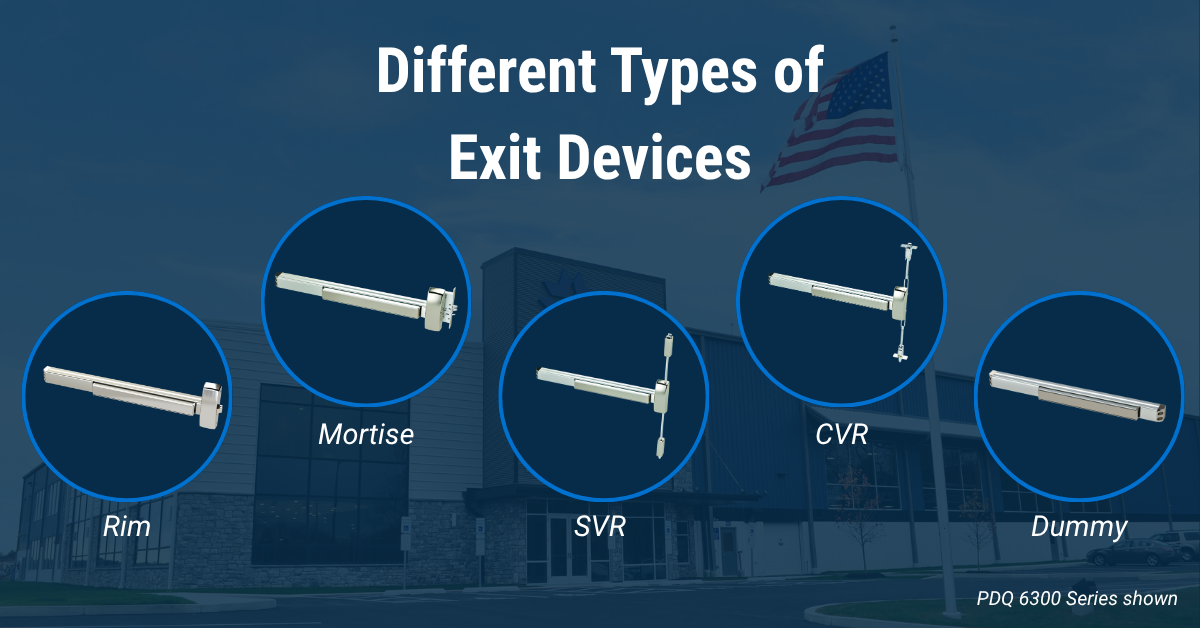
Exit devices are not one size fits all. There are a lot of factors that go into specifying the right exit device, from the door's construction, to whether it is a single door or part of a pair, and also how the latch needs to engage the frame.
PDQ's exit devices span the full range: the 6300 Series (wide stile) and the 6400 Series (narrow stile), each available in multiple configurations, plus a Dummy version (6300D) for vestibule applications where a functional device is not needed.
Rim Exit Devices
A rim exit device mounts to the surface of the door and latches into a strike on the frame. On a pair of doors, they latch into the edge of the inactive door.
It is the most common and typically the most economical configuration, available as the 6300R (wide stile) or 6400R (narrow stile). Rim devices work well on single doors and are often the default choice when there is no fire rating or aesthetic requirement pushing toward a different configuration.
Mortise Exit Devices
A mortise exit device integrates with a mortise lock body installed inside a pocket cut into the door, rather than mounting on its surface. PDQ's 6300M Series pairs with the MR Series mortise lock body for a cleaner, lower-profile appearance than a rim device, and is common on higher-end openings where the lockset and exit device share components.
Surface Vertical Rod (SVR) Exit Devices
A surface vertical rod (SVR) exit device uses vertical rods mounted on the face of the door that extend into the frame at the top and bottom, latching into strikes at the head and threshold. Pushing the bar in retracts both rods at once, releasing the door at the head and threshold in a single motion.
That two-point latching makes SVR a common choice for pairs of doors and openings with higher security or wind-load requirements. PDQ offers SVR configurations as the 6300V and 6400V.
Concealed Vertical Rod (CVR) Exit Devices
A concealed vertical rod (CVR) exit device latches at the top and bottom of the door like an SVR, but the rods run inside the door instead of across its face, for a cleaner, more finished appearance. CVR devices, such as PDQ's 6300C and 6400C, are a common upgrade when the look of the opening matters, such as a main entrance, but the door still needs top-and-bottom latching.
Explore the 6300 and 6400 Series across PDQ’s Exit Device Lineup for full configuration details.
Panic Hardware vs. a Standard Door Lock: What's the Difference?
Even though both control access through a door, panic hardware and standard locksets serve different purposes. Standard locks are what you normally think of: a deadbolt, a cylindrical lock or mortise lock that require the insertion of a key.
Panic hardware allows fast exit from the pushing of the horizontal bar. This is the key difference; both secure doors, but a standard lock can cause problems when lots of people need to leave at once through a set of doors.
Codes require panic hardware on doors serving assembly, educational, or high-occupancy spaces where a crowd needs to exit quickly. Standard cylindrical and tubular locksets remain the right choice for openings that are not a primary means of egress.
Do Double Doors Need a Mullion?
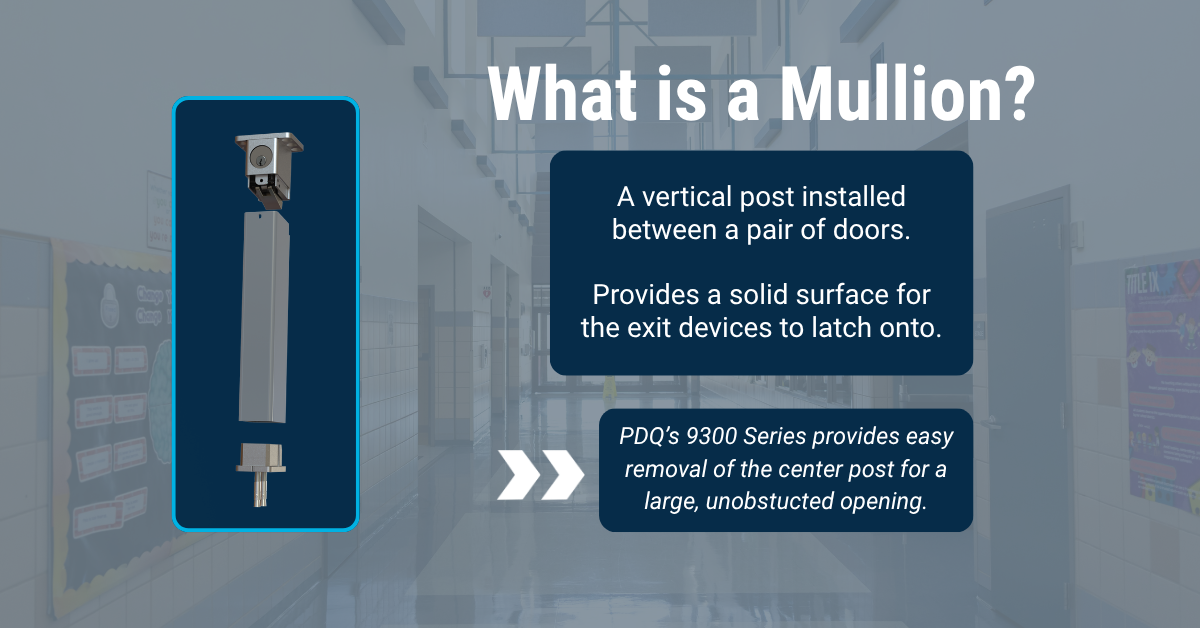
Often, yes. When a pair of doors both need panic hardware, each door typically needs its own strike surface to latch into. A mullion, which is a vertical post installed between the two doors, gives each door's exit device something solid to latch into. PDQ's 9300 Series removable mullion is built for exactly this: the center post removes when the full opening width is needed, such as for moving furniture through the doorway.
When Is Panic Hardware Required by Code?
Code requirements for panic hardware depend on occupancy classification, occupant load, and door width, and are governed primarily by the International Building Code (IBC) and NFPA 101, the National Fire Protection Association's Life Safety Code.
What Options Are Available for Exit Devices?
Beyond the base exit device, PDQ's 6300 and 6400 Series can be configured with options to match specific project requirements.
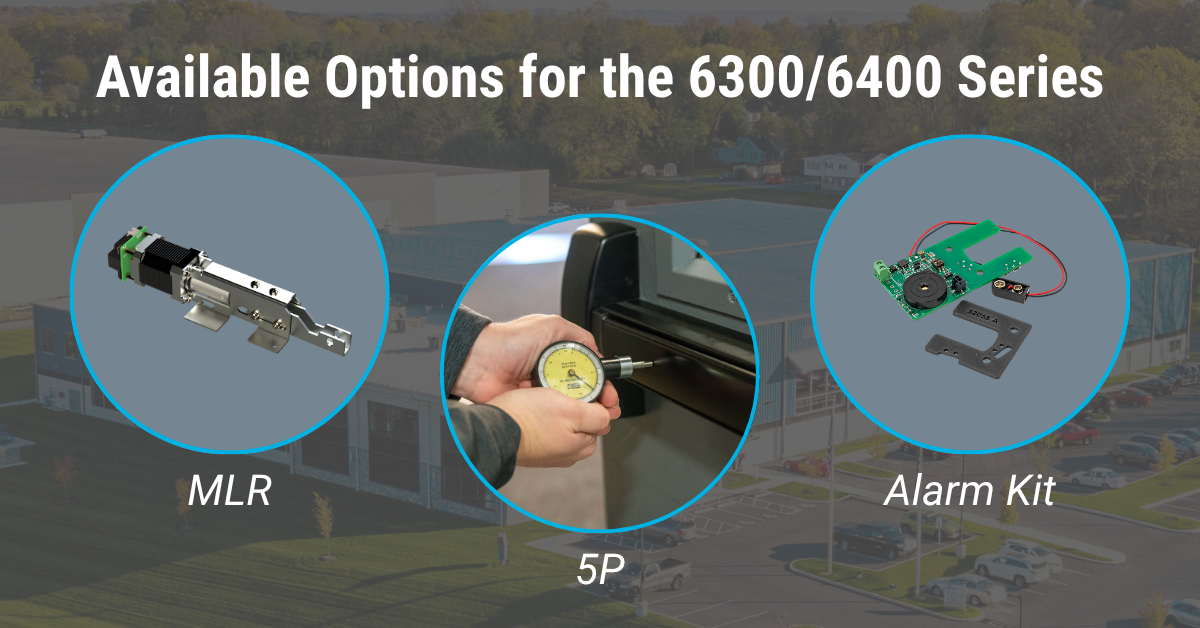
Motorized Latch Retraction (MLR)
Motorized Latch Retraction (MLR) is an electrified option that retracts the exit device's latch automatically, typically triggered by an access control system. MLR is what allows an exit device to work inside access-controlled openings, letting a facility manage entry from outside while the device still guarantees free egress from inside. The addition of the electronic parts for MLR adds cost compared to a standard exit device, so specify it only where the project genuinely needs access control integration.
Low-Force / Accessibility Options
PDQ's 5P option limits the force required to operate an exit device to 5 lbs. or less, benefiting anyone with limited grip strength or mobility, including elderly users, children, and people with disabilities. It is available on the 6300 and 6400 Series in Rim, CVR, and SVR configurations, built to meet ADA push-force and height requirements under California Building Code 2022 Section 11B-309.4 and Americans with Disabilities Act (ADA) 2010 Section 309.4.
Alarm Kits
An alarm kit adds a local audible or visual alarm to panic hardware. This option is commonly added on for delayed egress exit devices or alarmed-door applications where a facility needs a short warning before a door releases or simply needs to know when one has been used.
How Do You Choose the Right Exit Device for Your Opening?
Choosing the right exit device comes down to a few concrete decisions about the opening itself:
- Door width and stile type: Wide stile doors typically call for the 6300 Series, narrow stile doors for the 6400 Series.
- Fire rating of the opening: Fire-rated doors carry their own hardware and labeling requirements; see fire-rated door requirements.
- Single door vs. pair: A pair may need a mullion (see above) or a vertical rod configuration so both doors latch independently.
- Aesthetic and trim preferences: A mortise or concealed vertical rod device gives a cleaner look than a rim device, which matters on visible, public-facing openings.
- Electrification or access control needs: If the opening needs to integrate with access control, specify MLR up front rather than retrofitting later.
- Accessibility requirements: Openings that need to meet California or ADA operating-force requirements should specify the 5P option.
Grade matters too. PDQ's 6300 and 6400 Series are built to Grade 1 standard for strength and durability in demanding environments. For more information on panic bar grades, see Grade 1 vs. Grade 2 panic bars which breaks down how to match the right grade to your opening's traffic level and durability needs.
Key Takeaways
- Panic hardware, exit device, panic bar, crash bar, and push bar all refer to the same door-mounted egress mechanism, governed by ANSI/BHMA A156.3.
- Pushing the bar or pad inward retracts the latch, allowing fast and easy egress in the event of an emergency
- PDQ's full exit device lineup covers Rim, Mortise, SVR, CVR, and Dummy configurations so you can match each door in your project to the right solution
- Pairs of doors with panic hardware often need a mullion, like PDQ's 9300 Series, to give each door a strike surface.
- Motorized Latch Retraction, alarm kits, and the 5P low-force upgrade are all options you can configure to your specified exit device.
- The right exit device depends on door width and stile type, fire rating, single door vs. pair, aesthetics, electrification needs, and accessibility requirements.
Specify Your Exit Devices with PDQ
Panic hardware isn’t something you can afford to get wrong. Making sure you have the right exit device for your building the first time saves you from trouble down the road. Knowing the basics of panic hardware is just the beginning.
PDQ’s Exit Device Line is Grade 1 certified, giving you the confidence knowing that it will be able to handle your most demanding openings. Need to specify panic hardware? Talk to a PDQ expert to find the right solution you need for your project.